Saving A Bird….Saving A Life


My father was an animal lover. We had dogs, cats and birds as pets at home. But that was before my birth. I have only seen dogs around me. In fact, when I was born my father brought home a baby Duchshund. Mother brought us up both together.

No wonder I am not a cat or bird person. But as fate would have it there had been two previous occasions when injured pigeons fell on my balcony and in spite of my sincere efforts to save them they succumbed. Naturally I felt terrible thereafter.

Two days back I found a baby pigeon in the space where I keep my plants. Kalu, one of my stray pets, was trying to intimidate her by pawing the fence and growling. I managed to quieten Kali and placed a bowl of water and a few grains of rice on a plastic plate near the tiny thing. After a while I found her perched on the water bowl and pecking at the grains. 

Rinky’s erstwhile dog walker is still in touch with me. He assists our local vet. I asked him to come and have a look at the poor thing. However , by this time it was apparent that she had an injured leg which was swollen. Perhaps she did not even know how to fly or just learning. Must have been accidentally separated from her mother and unable to go back to her now. However, the mother pigeon was nowhere to be seen. I had expected her to come seeking her baby but she did not. Perhaps it is not in their system of things. Unfortunately, our local vet had no experience of treating birds. The only option was to take her to a bird hospital.

Two nights passed before I could find a nearby bird hospital. These two nights were crucial because I had to save the baby from rodents and big crows. A plastic basket came in handy as a makeshift cage. A thick rug was tucked in to plug the slight gap in between the rim of the upturned basket and the ground. In the mornings I’d check  with a thumping heart whether she was still breathing.
Fortunately, one of the neighbours has a close association with a bird hospital nearby. It is maintained by the Jain community. This afternoon we delivered the baby there. What a relief!! It was really satisfying to see how well kept the hospital was – big, spacious, airy and very clean. The cages were full of chirping birds – grey and white pigeons, parrots, peacocks and many other small ones.

We were assured that the baby would be okay with proper treatment. They also informed that they’d set the bird free once she was able to fly.

Tonight I will sleep in peace. I am thankful to God that He made me an instrument to save a tiny life. It is oddly humbling and most gratifying.

A Little Theory Of My Own


Many years back a knowledgeable person had told me that amazing similarities could be found in words spoken in different languages in different parts of the world. He had given me the example of the Italian word “Vedova” for the English word “widow”. More surprising is its corresponding words in Hindi and Bengali. In Hindi a widow is called “vidhva” and in Bengali she is called “Bidhoba”. The difference is only of pronunciation.

The German word “wagen” and the words “vahan” in Hindi and Baahon in Bengali refer to the same thing – a carrier or a vehicle. In English it is wagon.

For the word “mother” the Sanskrit is “Matah”. In pure Hindi and Bengali it’s Mata. For the word “father” the Sanskrit is “Pitah”. In pure Hindi and Bengali it’s Pita. Where is the connection? In Hindi and Bengali the alphabets M and F belong to the same group of consonants – the “Pa Varg” which goes like this –

Pa , Pha, Ba, Bha, Ma.

In English the corresponding alphabets are –

P, F, B and M.

So, the interesting similarity in the words mother and father is that their Hindi and Bengali corresponding words also start with the same consonants or one of the consonants of the same group.

The English language has generously borrowed from Sanskrit, Hindi, Urdu, Arabic, Persian, Bengali and many other languages as the English voyaged worldwide. This is evident in words like Juggernaut, Bazaar, Guru, Yoga etc. My mother tongue Bangaal , a dialect of East Bengal now Bangladesh, leans heavily on Urdu and Hindi vocab. In the Bengal Bihar border the Bengali spoken has a distinct Hindi accent.

It’s also funny that some of the words of English language have come to be incorporated in the colloquial dialect of Hindi with an entirely different meaning from the original one. For example, in English the word “item” means an article or object. In Hindi if the same word is used with reference to the feminine gender it assumes a definitive salacious undertone  – a slang “objectifying” woman.  In cinematic lingo an “item song” means a raunchy , foot tapping number to break the grim mood of a narrative.

I am not a linguist. But I have a love for words and languages, their etymology, their cultural adaptation and travel through history and how similar sounding words in different languages have the same or sometimes completely different meanings.

I am sure while reading this post you may be reminded of many such words in your own language. Please mention them in your comments for enriching the discussion further.

For You


I leave behind

A half written note

A few haphazard scribbles

A laundry list tapering into a haiku

A dogeared diary

A broom sticking out of a newspaper basket

A fistful of dust on the mop

I take back with me

What I had hoped to leave behind

A broken dream

An unsung song

An unread poem

And an empty home

Waving  goodbye

For Sadje’s #Whatdoyousee

What do you see # 361- 5 October, 2026

Season After Season


When we were small approaching winter meant unpacking warm woollens, quilts, blankets, heavy sheets and airing them to do away with the smell of the moth balls. The summer clothes were packed away.

Come summer the winter clothes were washed, folded and stacked in trunks. Neem leaves and moth balls were placed inside to protect them from insects and moths. And out came lighter wear.

Winter also saw the dhunaai of the old rajais to make them heavier, fluffier and warmer.

Dhunaai is “the traditional process of carding or fluffing up cotton fibers using a bow-string instrument (dhunki) before making a quilt, which involves heavy beating and striking.”

In case of old and over used rajais (traditional winter quilts) the covers were taken off and the stuffing of flattened  layers of cotton inside was thrashed or beaten up to clean and make them fluffy. Sometimes extra paddings of cotton was added too. The covers were either replaced if unusable or washed and ironed if still in reusable condition. Thus, nothing was wasted and there was no compulsion for buying new ones. In those days cotton mattresses were used and the same process was followed for bringing them back in shape and to renewed thickness. But I tell you  the threadbare quilts and blankets carrying the musty smell of over use felt the warmest.

Every household, in those days, had charpoys or charpais (char meaning four and pais meaning legs) which were portable cots made up of jute, cotton or coir ropes or strings tied to a rectangular, wooden or bamboo frame with four legs. These strings required periodical tightening as they loosened and  hung down over time with the pressure of body weight. After prolonged use the ropes needed to be replaced.

During winter afternoons the charpais were placed in the courtyards, terraces or outside in the gully where families and friends gathered and chatted – the ladies sitting on these charpais destemmed  spinach, fenugreek or mustard leaves or peeled and chopped vegetables for dinner. They knitted woollens for near and dear ones or did embroideries. And  shared designs or recipes and sometimes just plain gossips. The male members read the papers or discussed politics while the elderly enjoyed a good snooze under the winter sun.

In summer evenings the courtyards and terraces were cooled down by pouring buckets of water on the floors, beddings were spread on the charpais and pedestal or table fans were plugged in for the families to rest and retire for the night.

Some households also used the khaskhas chiks (traditional eco-friendly Khus or Vetiver blinds/curtains made from the aromatic roots of vetiver grass for covering the windows and doors) which were regulary sprayed with water to keep the rooms cool and fragrant. Room coolers came much later.

Large families having smaller dwellings slept outside placing the charpais in the gully. This arrangement also served as a safety net for the entire neighbourhood against trespassers. One of our househelps once narrated a funny anecdote. A thief who had entered their gully in the dead of the night inadvertently awakened the families sleeping outside. To save his skin the miscreant hid under our house help’s charpai. However, he ultimately got caught.

Summer thirsts were quenched by drinking naturally cooled water from the matkas or the earthen clay pots. New pots were bought every year and the old ones were thrown away. These were washed and kept overnight filled with water. The pot was emptied the next day and  refilled with fresh water. It was ready for use then. My father always added a pinch of edible camphor to the water for purification. It also gave the water a refreshing aroma and taste. Now we cannot think of life without water kept in the fridge.

Every year in the months of March (late spring) and April (early summer)  we have to now book the electrician/technician to get the Air conditioners serviced for optimum cooling in peak summers. In November the smog sets in and even the moon starts looking dusty. Depending on the tithi or date set up as per lunar calendar Diwali or the Festival of Lights  is celebrated during this time (October/November) with fireworks and burning crackers which add to the pollution.  The Air Purifiers thus have to be kept ready (cleaned and their filters checked/replaced as the case may be) in order to save our lungs from the pollutants. Mid winter sees unpacking of the Heat Convectors or Halogen/Oil Heaters  for adequately heating up the interiors.

Now nobody sleeps outside under the open city sky because it is not considered safe or healthy any longer. Dependence on artificial cooling and heating mechanisms have on one hand made life bearable in extreme weather conditions and on the other  given rise to technology induced ailments like allergy, dryness of eyes and skin, sore throat , chest congestion etc.

Conscious And The Subconscious


GenZ has taken to slow reading says an article in the daily. Choose a comfy spot – a garden, a bench, a corridor with least footfall – take a book and savour slowly every word, every line, every para , every page with no hurry to finish it. That is what is slow reading.

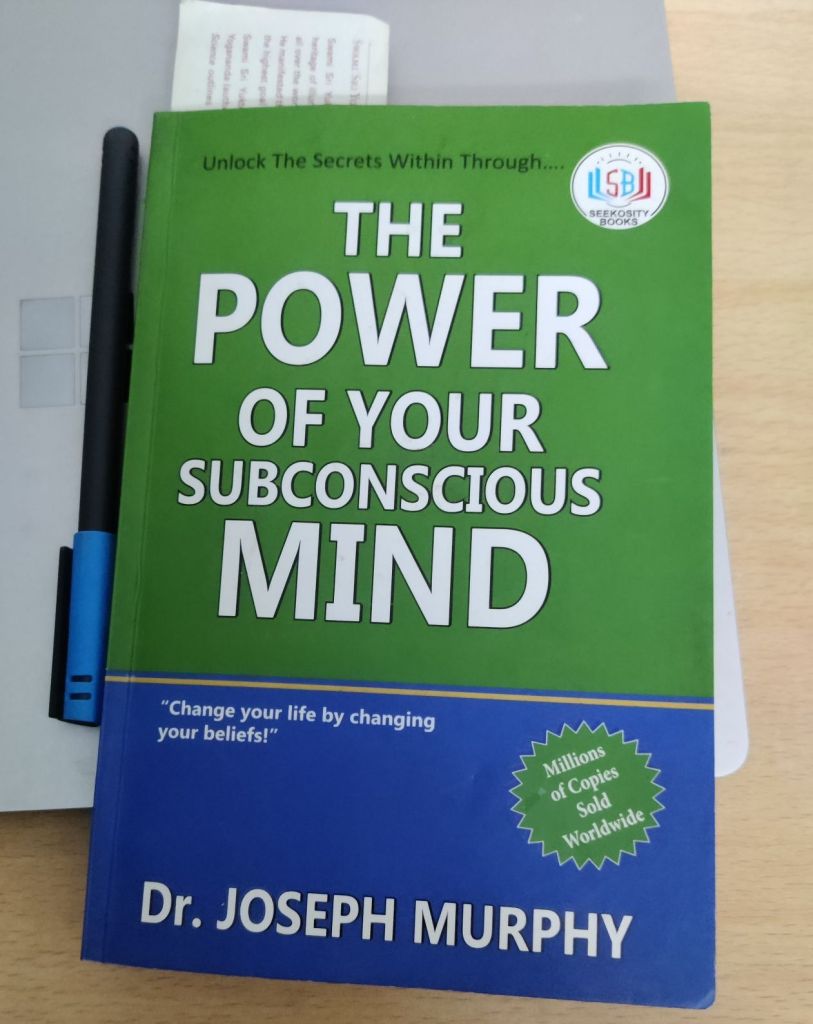
I too  read The Power Of Your Subconscious Mind by Dr. Joseph Murphy slowly for greater assimilation.

As we all know the human mind has two parts – the conscious and the subconscious. The conscious mind receives various inputs through the five sensory organs – eyes, ears, nose, tongue and skin. Its reactions to these inputs are  passed on to the subconscious as thoughts and beliefs. The subconscious is the storehouse. It is also the healing centre and the hub of creativity – the Infinite Intelligence.

Dr. Murphy tells us the various ways the potentials of the subconscious mind can be tapped to fill our lives with happiness, health, healing, peace and abundance. For this the conscious and the subconscious minds have to be in harmony with each other. He cites numerous case studies and generously quotes from the Psalms in favour of positive affirmations and prayers which can effectively bring about this harmonious alignment, thereby, allowing the manifestation of all the good in life.

The book is divided into twenty chapters. Each chapter ends with a summary of the content therein. A transformative read, it occasionally reminds of The Secret by Rhonda Byrnes.

A few points from Dr. Murphy’s chapter summaries:

Great men of all ages had the ability to contact and release the powers of their subconsciou mind.

The subconscious mind controls all the vital processes of the body and knows the answers to all problems. Prior to sleep turn over a specific request to your subconscious mind and witness its miracle working power.

Plant the seed of faith (idea) in your mind , water and fertilize with expectancy, confidence and conviction. Mentally and emotionally unite with that idea. What you consciously affirm do not negate or counter it after a few moments. This will neutralise the good that has been affirmed. Believe in the reality of your idea, plan or invention, and as you do, it will become manifest.

The tendency of the subconscious is lifeward. What you affirm consciously and feel as true will be made manifest in your mind, body and affairs. Affirm the good and see it manifest. Choose your thoughts cautiously. The subconscious accepts the dominant thought. It does not argue or contradict. Negative thoughts are stumbling blocks. Substitute the negative thoughts by positive thoughts.

You do not always get the answers overnight. Keep on turning your request to the subconscious mind. But you must not doubt or question its powers. Guidance comes as a feeling, an inner awareness , an overpowering hunch by which you know what to follow. Think wise and right to get the right response from the subconscious.

Right action, right thought, right belief, right words and right approach will direct you to peace, harmony, prosperity, security, happiness, health , creativity and wealth.

Love is understanding, good will and respecting the divinity of the other. Rejoice in the success, promotion and good fortune of the others. In doing so, you attract good fortune to yourself.

Shopaholism ?? No…No…


I am not a reckless squanderer. Nor am I parsimonious. My spending graph starts with caution and ends up in a spree. I am generally money wise but sporadically throw prudence to the wind. How is that defined? Shopaholism? Naah…!

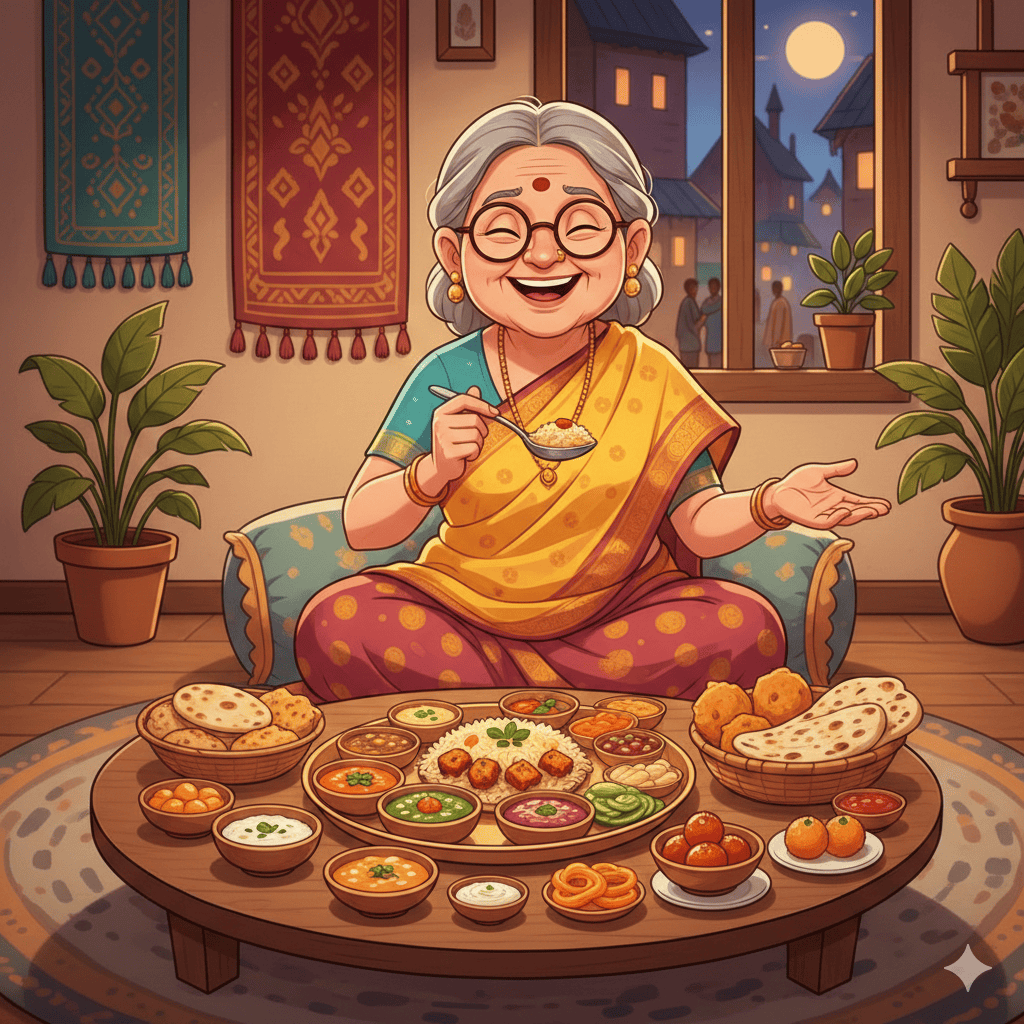
The other day when I learnt that my eye surgery was postponed I felt doomed. A clarion call for a morale booster!! It came in the form of epicurean delight ordered  from outside (shoo to a structured diet!). Anyway I relished the super creamy Chicken Labaadar with homemade jawar ki roti finishing up the yummylicious combo with two spongy gulab jamuns and  a resounding slurp of the sugary syrup the golden fried balls were paddling in.

The guilt gatecrashed the next morning, a little too late perhaps, but it sat with me for quite some time holding my hands till I made a promise to myself that one crime is enough for the month. By the way the month is pretty long of thirty one days with a festival knocking on the door. I can see the writing on the wall in bold  – “promises are made to be broken”.

A month back I had a firm mind not to give in to sartorial extravagance. My wardrobe, bursting at its frame, was in a slogan shouting competition…”cholbe na….cholbe na“. But come September the firmness hobbled. And why not  it is the most  cherished time of the year – mid October Durga Pujo!! Insta dutifully popped up reels after reels of drum rolls announcing the festivities and ladies draped in their opulent fineries welcoming Maa Durga.

Alas! I am a mere mortal. The Insta scrolls were quickly  replaced by online store binges. FB and all other oft visited sites extended their kindest help  in whipping up my glutton. How does Google read the minds of the scrollers? The ingenious hacker!! Chased the instigating ads  like the paparazzi. So, there was I tearing up nicely wrapped packages while the wardrobe shedded copious tears. A sudden peep at my UPI history landed a crashing punch to my sanity. Gosh!! How could I???

Well, if you think that was a blow crippling enough to throttle my vicious instincts then sadly you have put too much faith on my virtues.

Yesterday morning Didi enters with a bag full of the most sinful goodies. Remember she was out of city! Naturally, the conversation veered towards Pujo (read shopping). I insisted that I get her a new dress. She had the same lame excuse –

“I have enough.”

“But it’s Pujo. What about the tradition? A dress is not a dress. It’s symbolic.”

And then another temptation happily parachutes down on the balcony – B-I-L is in great need of a pair of shoes (all rubbish – he already has an envious collection) which makes us swiftly check out the brands.

Of course! It’s my topmost familial responsibility to help B-I-L get hold of the right pair. And if in doing so my eyeballs hover over the ladies’ section… Don’t worry, I trust my cataract to thwart the slightest move towards another avoidable acquisition.

In the meantime, I have suitably influenced Didi that I buy her  a new dress. The shopping destination  has also been decided. A local outlet which has the most exquisite variety and a bunch of ‘effectively’ pursuasive sales persons.

So, another outing is very much on the planner.

But no, I will be strict with myself. No fizul kharchi (unnecessary purchases).

But do you seriously think succumbing to guilty pleasures once in a while should be met with zero tolerance?

Well…eh….ahem…you are mistaken…it’s not a high profile case of corruption.

Blame the season which lifts the lid off the otherwise “un-shake-able” self control.

Otherwise I am genuinely a very wise spender.

Whatt? You don’t believe me??

C’mmon now…

Hehh….Hehh

Guilt


My right eye was scheduled to be operated for cataract on the eighth of this month. Yesterday evening I came to know that it had been postponed indefinitely. That upended all previously made plans.

My sister was incidentally out of town  on  important family duty. She cut short her stay to be with me for the surgery. B-I-L was in two minds about a business trip.

I called up my sister asking her to get a refund on the air ticket and stay put. She waived my suggestion saying I should not let her untimely return bother me. When I informed B-I-L he said we should wait and watch.

But I was taken aback by my own reaction. The overpowering guilt that took over me as soon as I came to know about the postponement not once remembering the fact that I was a sufferer as well who was at the moment most troubled by diminutive vision and other ancillary handicaps.

This guilt is not a standalone feeling. It emerges from a larger burden neatly plonked inside. Our thoughts have a greater role to play in our physical, emotional and mental well being than we give them credit for. 

Last year when I was going through a series of surgeries my most prominent thought was why I was going through the suffering. Wouldn’t it be much better that I exit from this world quietly since all my duties were over. Consequently, my recovery got delayed and ailments got prolonged. As it subsequently dawned upon me that there must be a divine purpose to my survival my health considerably improved.

Now, as the awakening follows that I owe myself much much more I guess every piece of this jigsaw puzzle is going to fall in place in no time.

So, I sit back and enjoy the autumnal hues.

And oh yes, another sprouted mushroom !

This time I am definitely going to keep a tab on the thief.

On that snooping note I sign off.

😂😂😂😂

An Uninvited Guest


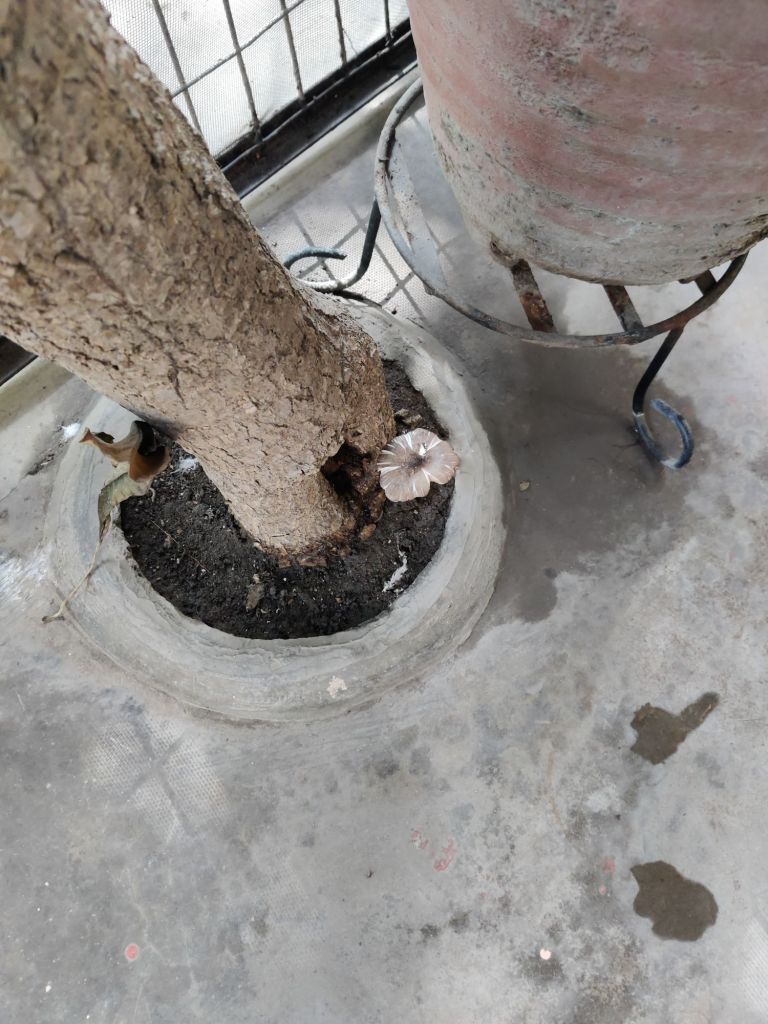
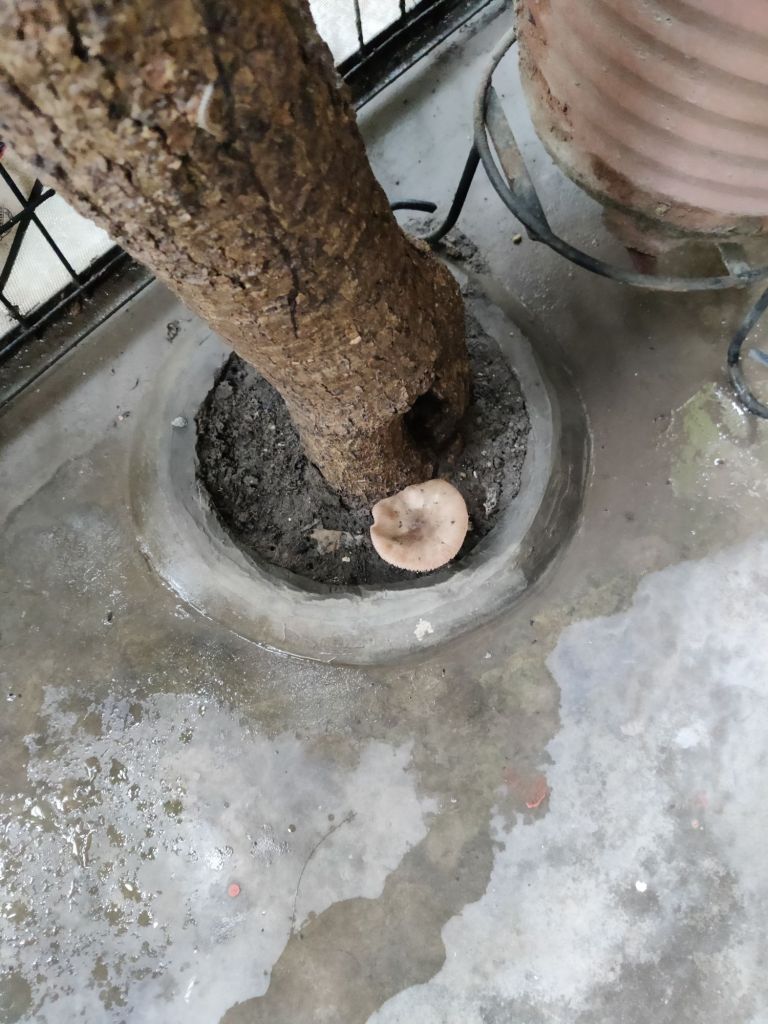
This year it hasn’t rained much but still for the first time a mushroom sprouted under the Champa tree.

I do not know who picked it up but it wasn’t there after a few days. Was it edible ? No idea. But its presence surprised and elated me.

The sad news is that the rodents have destroyed most of my plants. The other day I had left a handful of dog food for Chhin Chhin who showed total indifference to it and walked away haughtily. But soon after I saw two big fat rats stealthily making way towards the food. I scared them away by stamping my foot hard. Later I placed a brick on the manhole from where they had emerged. 

A chaotic scene takes place when I serve food for Chhin Chhin every afternoon. She is very choosy. Sometimes if the food is not to her liking she just turns her back but sits patiently for a better alternate. At times she does me a favour by accepting whatever I give her. As she eats a sentinel crow perched on the Champa branch caws to the full capacity of her lungs. I try to figure out her language which appears to me like, “Oh! She is eating away! She has eaten everything off the plate!! Oh God there’s nothing left for us. Oh! Oh! Now what will we peck on. And I am sure this old fatso is not going to give even a tiny morsel to us. Oh Lord! The immense cruelty…the enormous injustice of it all.”

I wish we could clamour like that in the face of unequal distribution, gross misappropriation and blatant mis-utilisation  of wealth and resources in the country!!

Will anyone hear us out??

Porcupine’s Thorn


Classics are timeless. Even if the genre is murder mystery these can be read again and again. One such Bengali novel is Shajarur Kantaa (Porcupine’s Quille) written by Sharadindu Bandopadhyay. The book was first published in 1967 featuring  Byomkesh Bakshi who prefers to call himself not a detective but a sattanweshi or a truth seeker.

South Calcutta is rocked by a series of random killings – first a roadside beggar, then a labourer followed by a shopkeeper and lastly a rich businessman. The unknown assailant employs a novel way of exterminating his targets by injecting a porcupine’s thorn into the hearts of the unsuspecting victims from behind.

His fourth victim, Debashish Bhatta, is the owner of Prajapati Prashadhon, a cosmetic factory. His employees respect him. He has got married just two months back. His wife, Deepa, hails from an aristocratic but conservative family. Debashish falls in love with Deepa at first sight. But Deepa confesses to Debashish on the night of their marriage that she loves someone else. She requests him to allow her to stay with him under the same roof but not as husband and wife. Debashish, a perfect gentleman, agrees.

Debashish leads a quiet life. In the same neighbourhood stays Nripoti Laha, a widower, in whose house, every evening a few bachelors meet for adda (friendly chit chat, games and music). Deepa’s brother is also part of the group. In fact, it is on Deepa’s brother’s request that Nripoti does the matchmaking between Debashish and Deepa. Nobody knows that Deepa and Debashish are not happily married because they pretend to be so in front of their family and friends.

One fateful evening Debashish receives a call from one of the boys in the group who wants to borrrow some money from him. Debashish accedes to his request. But while returning home he is attacked by the serial killer. However, Debashish is miraculously saved. While he is recuperating in the hospital the police come to interrogate him because it is an attempt to murder. The police inspector, who is a friend of Byomkesh Bakshi, brings the detective along to help him with the case.

Who is this serial killer? Anybody known to Debashish? Why does he want to remove him ? Byomkesh interrogates Debashish’s friends at Nripoti’s residence – the ecclectic group consists of a lonely widower, a well known film actor, an amateure star gazer, a rising singer and a famous footballer. All of them have their Achille’s Heels. All of them have secrets. Is the killer one of them?

Shajarur Kantaa reminds me of another classic – Agatha Christie’s The A B C Murders first published in 1936 wherein a serial killer murders his victims in alphabetical order and leaves an ABC Railway Guide at the crime scene. While the serial killing is merely to hoodwink the ace detective Hercure Poirot who is investigating the case, the actual target of the killer is someone else. Sharadindu’s  “porcupine killer” has a similar modus operandi but with a difference.

I read this very popular novel when I was in high school. A few years back I watched its televized version. A few days back I heard its audio adaptation. And everytime the thrill and suspense of the narrative kept me hooked. That speaks of the mastery with which the author has penned the story. The book has been translated in English. It is available in papaerback as well as on kindle.

September – A Monthly Wrap-Up


The highlights of this month have been two attempts at long meditation. The first one was near home – a short drive across the main road. I used to visit this Centre off and on during the last phase of my working life. The lady who heads it insisted that I did a short course with them to understand their philosophy. The discourse that followed required a lot of unlearning on my part in which I failed but it did provide me with a spiritual anchor.

This month when I went to the Centre we had a lot of catching up to do. She again insisted on a recapitulation of the earlier discourse which took up time. Since I had only half an hour in hand the meditation had to be cut short. A disappointment!

One of my sister-in-laws is into Buddhist chanting. I wanted to experience their monthly group chant but due to my prolonged illness it was stalled. This month when I expressed a desire to attend  she readily agreed and Whatsapped the date. Though it was at the other end of the city being a Sunday the roads were clear of traffic and it took me just an hour to reach.

It was a welcoming group of six people – four less than the usual ten who could not attend for some reason or the other. The chant was relaxing followed by reading, singing and experience sharing. Personally, I would have preferred a longer chant. At the end of the session, my sister-in-law handed me some reading materials which I intend to go through. The group insisted that I become a regular.

Let’s see what the next month brings along…

Written for Natalies’s  Monthly Wrap-Up